The Guides
Handmade vs mass-produced bridal jewellery
How do you choose between a piece handmade by a master artisan and a mass-produced one? This guide compares quality, price, durability and personalisation to help you find the perfect piece for your wedding.
In short
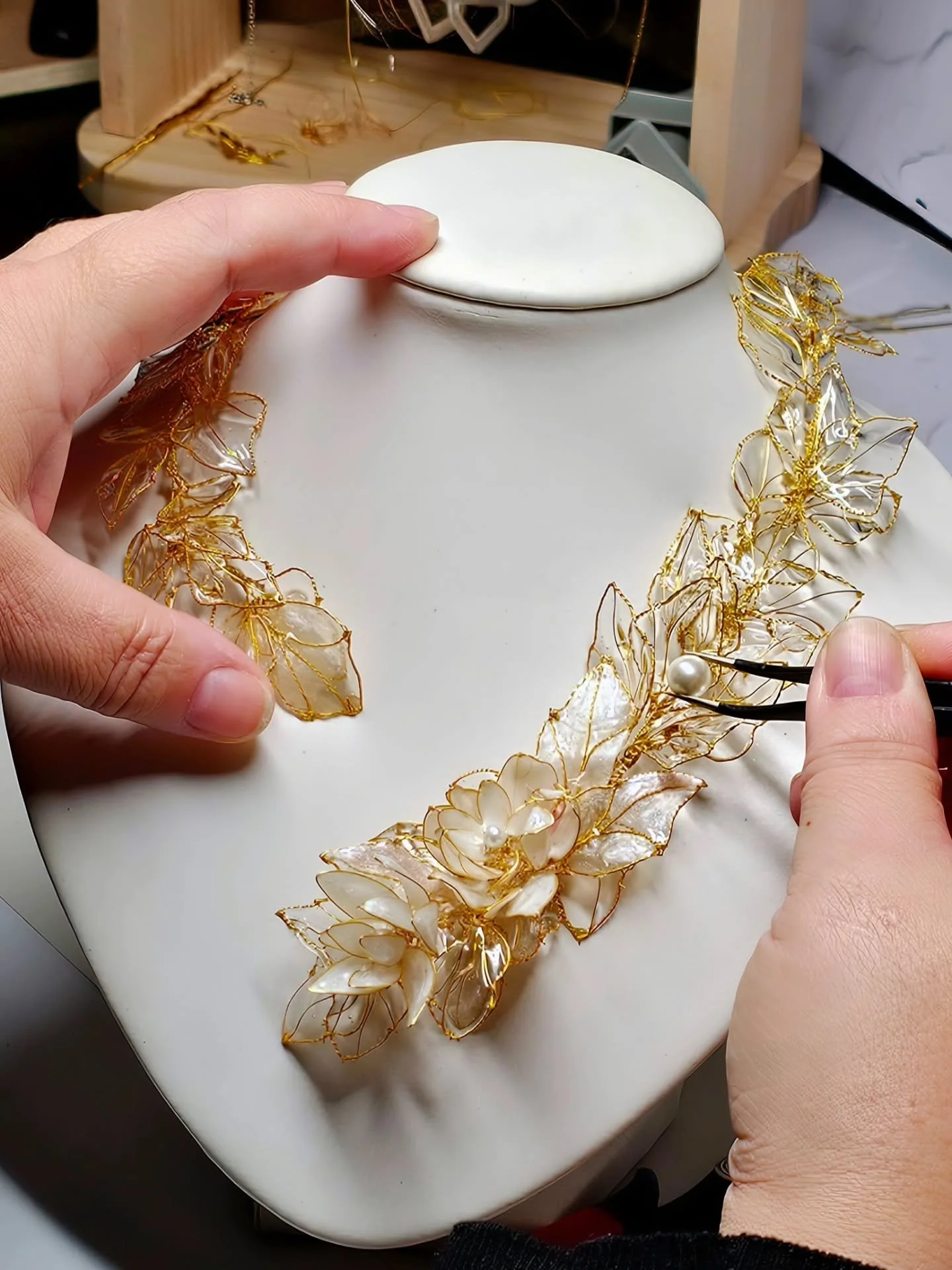
Handcrafted bridal jewellery offers superior quality, complete personalisation and a one-of-a-kind piece. It costs €25 to €450 and requires 15 to 40 hours of handwork. Mass-produced jewellery is more affordable (€10 to €80) but made in series with standardised materials.
For their wedding, 82% of French brides prefer unique or personalised accessories, according to a 2025 Mariages.net study. If the budget allows, a handcrafted piece becomes a keepsake to pass down, not a disposable accessory.
Full comparison table
| Criterion | Handcrafted | Mass-produced |
|---|---|---|
| Manufacture | 100% handmade, 15–40 hrs per piece | Machine-made, a few minutes per piece |
| Uniqueness | One-of-a-kind or very limited run | Hundreds to thousands of copies |
| Materials | Fine: fine gold, mother-of-pearl, resin | Alloys, rhinestones, plastic |
| Personalisation | Complete: made to measure for your gown and hairstyle | None or very limited |
| Price | 25€ – 450€ | 10€ – 80€ |
| Lead time | 7 to 14 days (made to measure) | Immediate (in stock) |
| Durability | Several decades with proper care | 1–2 years before deterioration |
| Repairs | Repair service by the artisan | Not repairable, must be replaced |
| Environmental footprint | Low: local production, small runs | High: mass production, shipping |
| Sentimental value | High: a story, an heirloom | Low: a consumer product |
| Guidance | Personalised consultation | Self-service retail |
1. Quality of materials
A handcrafted piece uses fine materials selected by hand : brass plated with 24-carat fine gold, genuine mother-of-pearl beads, resin and freshwater pearls. Each component is chosen for its quality and durability.
Mass-produced jewellery prioritises production cost. It uses zinc or tin alloys, glass or plastic rhinestones, and thin electroplated gilding that wears off after a few uses. Several artisan jewellers point out that handmade work allows materials, finishes and proportions to be chosen with a precision that industry finds hard to standardise. Quality of materials thus becomes the first real point of difference.
2. Uniqueness and personalisation
Every handcrafted jewel is a one-of-a-kind piece. Even within a collection, subtle variations make each creation irreplaceable. Bespoke goes further still: the artisan designs a piece specifically tailored to your gown, hairstyle and figure.
At Le Baiser de la Mariée, the bespoke process includes:
- Consultation — share photos of your gown and your inspiration
- A conversation within 48 hours — by video call, phone or a visit to the workshop in La Destrousse
- Handcrafted creation — 15 to 40 hours of handwork
- Delivered in a gift box — prepared within 7 to 14 days
A mass-produced piece, even a “customisable” one, is limited to a choice of size or colour from predefined options.
3. Durability and heritage
A handcrafted piece made from fine materials lasts for decades. With proper care (see our care guide), your crown or earrings can become a family heirloom, handed down from mother to daughter.
Most artisans offer a repair service. At Le Baiser de la Mariée, every creation benefits from this service — a damaged piece can be restored rather than thrown away.
Conversely, a mass-produced piece whose plating wears off or loses a rhinestone usually cannot be repaired. Its typical lifespan is 1 to 2 years before visible deterioration.
4. Environmental and ethical impact
Local craftsmanship has a significantly lower carbon footprint than industrial production. A piece handmade in Provence travels a few kilometres before reaching you. A mass-produced piece is often made in Asia, shipped by cargo vessel, stored in a warehouse, then dispatched.
Directories dedicated to French-made goods also stress the importance of traceability, place of manufacture and a direct relationship with the workshop. Choosing jewellery made in France also means supporting local jobs and preserving artisan skills threatened by mass production.
5. Price: understanding the difference
Yes, a handcrafted piece costs more. But that price reflects:
- 15 to 40 hours of handwork per piece
- Fine materials: fine gold, mother-of-pearl, resin
- Personalised guidance from start to finish
- A one-of-a-kind piece that cannot be reproduced identically
- Free repairs for 10 years (10-year guarantee)
Price ranges at Le Baiser de la Mariée:
Free delivery in France on orders from €200.
Our verdict
If your budget allows, a handcrafted piece is the best investment for your wedding. You wear a one-of-a-kind piece, created especially for you, that will last for decades. It is a keepsake in its own right, not just an accessory.
For tighter budgets, some artisans offer more affordable ranges. At Le Baiser de la Mariée, creations start at 25€ and bespoke pieces at 100€, which remains competitive with “premium range” mass-produced jewellery.
Ready to choose handcrafted?
Discover our creations handmade in Provence, or create your own bespoke piece.
Frequently asked questions
What is the difference between handcrafted and mass-produced bridal jewellery?
Handcrafted jewellery is made by hand by a master artisan, and each piece is unique. Mass-produced jewellery is made in series by machines. Less than 5% of jewellery sold in France is genuinely handcrafted.
Does handcrafted jewellery cost more?
Yes, because each piece requires 15 to 40 hours of handwork with fine materials. At Le Baiser de la Mariée, prices range from €25 to €450. Some “premium” mass-produced jewellery costs just as much, without the artisan quality.
How long does it take to receive a bespoke piece?
Allow 7 to 14 days of preparation after approval: consultation, design and handcrafting. At Le Baiser de la Mariée, Catherine will contact you within 48 hours of your request.
Can a handcrafted piece be repaired?
Yes, most artisans offer a repair service. At Le Baiser de la Mariée, every creation benefits from a repair service, unlike mass-produced jewellery, which generally cannot be repaired.